Most businesses don’t really struggle because they lack customers. They struggle because they can’t keep up when those customers actually start talking to them.
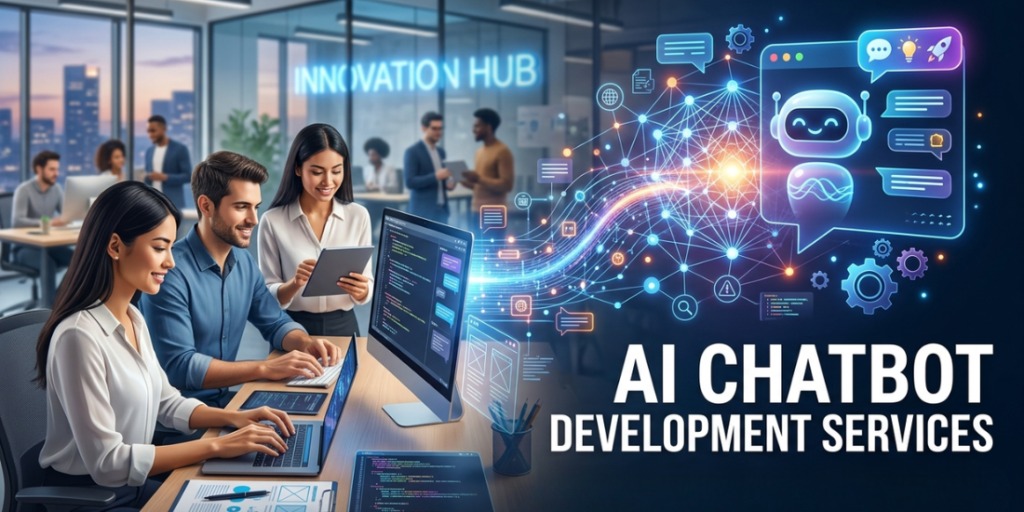
Someone visits your website at 11 PM with a question. Someone else wants a quick answer before buying. Another person just needs help figuring something out. And if nobody responds fast enough, they usually just leave. That’s basically where AI chatbots started becoming useful in a very real way. Not as some futuristic idea. Just something that helps you stay available when your team can’t be online every second. This is what AI chatbot development services are really about when you strip away all the technical talk. At HiveNexis, we usually explain it very simply to clients: it’s like having someone on your team who never sleeps, never gets overwhelmed, and can still talk to hundreds of people at the same time without dropping the ball.
So what is an AI chatbot Development Services in simple terms?
Forget the complicated definition for a second.
An AI chatbot is just a system that talks to your customers in a way that feels somewhat natural. It answers questions, guides people, and helps them get things done without waiting for a human agent.
The better ones don’t just follow scripts. They understand what someone is trying to ask, even if it’s not written perfectly.
And these days, they’re not limited to websites anymore. You’ll see them on WhatsApp, Instagram, apps, even inside internal business tools.
Why so many businesses are using them now
It’s not really because chatbots are “cool” anymore. That phase is over.
It’s more practical than that.
Most companies start using them because:
- They keep missing leads after working hours
- Support teams get flooded with the same questions
- Customers expect instant replies now (waiting feels outdated)
- Hiring more people for basic queries gets expensive fast
A chatbot doesn’t fix everything, but it does remove a lot of repetitive pressure.
And when it’s built properly, people don’t even feel like they’re talking to a bot anymore—they just get answers quickly and move on.
That’s usually the goal HiveNexis focuses on when building these systems. Not making it “AI-heavy,” but making it actually useful.
What makes a chatbot actually good
You’ve probably interacted with bad chatbots before. The ones that don’t understand anything and keep looping the same answers.
A good one feels completely different.
Here’s what actually matters:
- It understands intent, not just exact words
- It doesn’t break the conversation flow
- It can pull real data when needed (orders, bookings, etc.)
- It remembers context at least within a session
- It doesn’t feel like you’re talking to a broken menu
When all that works together, people stop caring whether it’s AI or not. They just care that it helped them.
That’s usually the difference between a chatbot people ignore and one they actually use.
Where chatbots are actually being used right now
Almost every industry is experimenting with them in some form, but a few stand out.
In online stores, chatbots are basically acting like shopping assistants. Helping people decide, comparing products, tracking orders.
In healthcare, they’re handling appointment bookings and basic queries so staff aren’t overloaded.
In finance, they’re answering account-related questions quickly instead of making people wait on calls.
In education, they’re guiding students through admissions and course details.
And in travel, they’re helping with bookings, cancellations, and updates.
It’s not really about replacing humans. It’s more about removing the boring repetitive stuff.
How chatbot development usually works
Most people think you just “build a bot and plug it in.”
It’s a bit more layered than that.
First, you figure out what the business actually needs help with. Not every chatbot has the same job.
Then you design how conversations should actually feel. This part matters more than people expect, because tone can completely change user experience.
After that, the system gets built and connected with your tools—website, CRM, databases, whatever is needed.
Then it gets tested with real scenarios, not just ideal ones. Because users don’t ask questions the way you expect them to.
And even after launch, it keeps improving based on real interactions.
At HiveNexis, we usually tell clients the truth upfront: the chatbot gets better after it goes live, not before. That’s normal.
Picking the right development team actually matters
This is where a lot of businesses go wrong. They either pick something too cheap and limited, or something overbuilt that doesn’t match their needs.
A good team should feel like they’re trying to understand your business first, not just sell you a package.
You want people who:
- Ask questions about your customers, not just features
- Don’t overcomplicate things you don’t need
- Build something you can actually manage later
- Stick around after launch when real issues show up
That’s generally how HiveNexis approaches it. Less about “selling a chatbot,” more about building something that actually fits into your workflow.
Where all this is going next
Chatbots are getting more natural over time. Less robotic, more conversational.
We’re already seeing:
- Voice-based chat instead of typing
- Bots that generate more human-like replies
- Systems that understand context across longer conversations
- Better personalization based on user behavior
It’s slowly shifting from “answering questions” to “actually assisting users.”
Still early, but moving fast.
How this actually helps business growth
Most people think chatbots are just a support tool.
But they quietly affect revenue too.
They help by:
- Catching visitors who might have left
- Guiding people toward the right product faster
- Reducing abandoned carts
- Collecting leads without extra effort
- Improving response time (which affects conversion more than people think)
It’s not flashy. It just reduces friction everywhere in the customer journey.
And less friction usually means more conversions.
Final Thoughts
At the end of the day, AI chatbot development services aren’t about replacing people or sounding futuristic.
They’re just a way to stay responsive without burning out your team or losing customers in the gaps.
And when they’re done right, they don’t feel like “AI tools” at all.
They just feel like your business is finally keeping up with how fast customers expect things to move.
Do I really need a chatbot for my business?
Not every business needs one, but if you get repeated questions or lose leads after hours, it usually makes sense.
Is it hard to manage after it’s built?
If it’s built properly, not really. Most updates are small tweaks, not full rebuilds.
Can it talk like a human?
To an extent, yes. It depends on how it’s designed and trained.
Will it replace my support team?
No. It usually just handles the repetitive stuff so your team can focus on actual problems.
Why HiveNexis?
Because we don’t treat chatbots like templates. We build them around how your business actually operates.