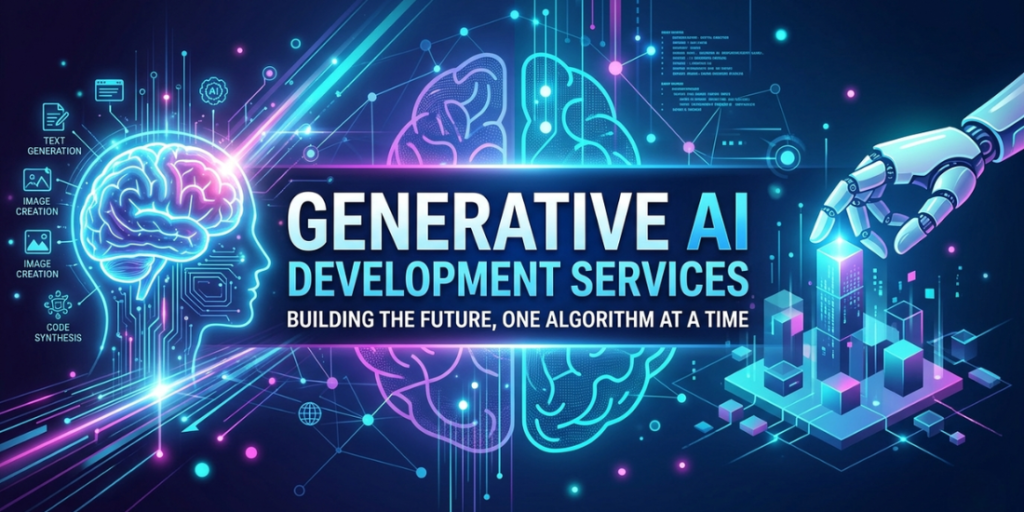
Generative AI is everywhere right now and not in a hype-only way. Businesses are actually using it to write content, assist customers, speed up development, and experiment with ideas that would’ve taken weeks before. But once you move past the excitement, a very practical question shows up: who’s going to build this for you? That’s where generative AI development services come in. And choosing one isn’t as simple as picking the first company that claims AI expertise. Some vendors are genuinely skilled. Others are just repackaging existing tools with fancy language. The difference matters more than you might expect. Let’s walk through what these services really involve and how to choose one without wasting time or budget.
What generative AI development services actually include:
At a glance, it sounds straightforward: build an AI model, plug it into your system, done. In reality, it’s a bit messier than that.
Good generative AI development usually starts with understanding your actual problem. Not the buzzword version of it, but the real, day-to-day challenge.
From there, the provider figures out what kind of model makes sense, whether it needs fine-tuning, and how it will fit into your existing setup. There’s also a lot of behind-the-scenes work cleaning data, testing outputs, and fixing edge cases that doesn’t get talked about enough but makes all the difference.
In other words, it’s less about building AI and more about making something genuinely useful.
Why businesses are taking generative AI seriously
A year or two ago, a lot of companies were just experimenting. Now, many are seeing real results.
Teams are getting more done without expanding headcount. Digital marketing departments are producing content faster. Developers are cutting down repetitive work. Even small businesses are finding ways to automate things they used to handle manually.
There’s also a momentum factor. Once one competitor adopts AI and starts moving faster, others feel the pressure to keep up. That doesn’t mean you should rush into it blindly, but waiting too long can put you at a disadvantage.
Still, the benefits only show up when the solution is done properly. A rushed or poorly implemented system can easily create more problems than it solves.
Different types
Not every provider offers the same kind of help, and this is where things can get confusing.
Some focus on building fully custom solutions from scratch. That’s usually the best route if your needs are specific, or your workflows are complex. It takes more time, but the end result fits better.
Others lean more toward consulting. They help you figure out where AI fits into your business and what’s actually worth building. This can be surprisingly valuable, especially if you’re still in the early stages.
Then there are teams that specialize in integration, basically making sure the AI works smoothly with the tools you already use. It sounds simple, but this part can get tricky fast if your systems weren’t designed with AI in mind.
And finally, some providers focus heavily on fine-tuning models so they sound like your brand, understand your data, and produce more accurate results.
How to evaluate generative AI service providers
This is where a lot of people get stuck. On paper, many providers look similar.
Here are a few things that actually help separate the good ones from the rest:
- They can explain what they do without hiding behind jargon
- They’ve worked on projects that are at least somewhat similar to yours
- They ask you detailed questions instead of jumping straight to solutions
- They’re honest about limitations, not just benefits
- They offer support after the initial launch
Beyond that, pay attention to how they communicate. If it’s hard to get clear answers early on, it usually doesn’t improve later.
Also, don’t ignore your gut feeling. If something feels off, pricing, timelines, or overpromising it’s worth taking a step back.
Understanding the cost
If you’ve already looked into pricing, you’ve probably noticed how inconsistent it is. That’s because there’s no one-size-fits-all answer.
A simple chatbot built on an existing model will cost far less than a fully customized system trained on your internal data. Add in integration, ongoing maintenance, and scaling, and the numbers can shift quite a bit.
Here’s what typically affects the cost:
- How complex the solution is
- Whether you need custom model training
- The amount and quality of your data
- Integration with existing systems
- Ongoing updates and support
It’s tempting to go with the cheapest option, but that can backfire. A low-cost solution that doesn’t quite work still costs you time, effort, and missed opportunities.
Common challenges
Generative AI sounds smooth in demos. In practice, there are a few bumps along the way. Data is a big one. If your data is messy or incomplete, the output won’t be great. That’s not a model problem, it’s a data problem.
Accuracy is another issue. These systems can sound confident even when they’re wrong, which can be risky depending on how you use them.
Then there’s integration. Older systems don’t always play nicely with newer AI tools, and that can slow things down.
Here are some of the most common challenges businesses run into:
- Inconsistent or low-quality data
- Outputs that sound right but aren’t fully accurate
- Difficulty connecting AI with existing tools
- Higher-than-expected setup time
- Concerns around privacy and compliance
None of these are deal-breakers, but they do need to be managed properly.
Where generative AI is heading next
Things are moving quickly, and what feels advanced today might be standard in a year.
We’re already seeing systems that can handle multiple types of content, text, images, and even audio, all in one place. That opens the door to more interactive and flexible applications.
There’s also a shift toward collaboration rather than replacement. Instead of AI taking over jobs, it’s being used to support people and make their work easier.
At the same time, regulations are starting to catch up. Businesses will need to pay more attention to how their AI systems handle data and make decisions.
Final thoughts
Choosing generative AI development services isn’t just about finding someone who can build something. It’s about finding a team that understands what you’re trying to achieve and is realistic about how to get there.
Take your time with the decision. Ask questions. Challenge assumptions. A good partner won’t rush you; they’ll help you think things through.
Done right, generative AI can genuinely improve how your business operates. Done poorly, it’s just another expensive experiment.
What is generative AI development?
They’re services that help businesses build and use AI systems capable of generating content like text, images, or code.
How do I choose the right provider?
Focus on real experience, clear communication, and whether they understand your specific needs, not just their technical skills.
Is generative AI expensive to implement?
It depends on what you’re building. Simple solutions can be affordable, while custom systems require a larger investment.
Can small businesses use generative AI?
Yes, many solutions are scalable and can be adapted to smaller teams and budgets.
What are the biggest risks?
Data quality, inaccurate outputs, and integration issues are some of the most common challenges.
How long does it take to build a solution?
It varies, but most projects take anywhere from a few weeks to several months depending on complexity.
Do I need technical knowledge to get started?
Not necessarily. A good service provider should guide you through the process in simple terms.