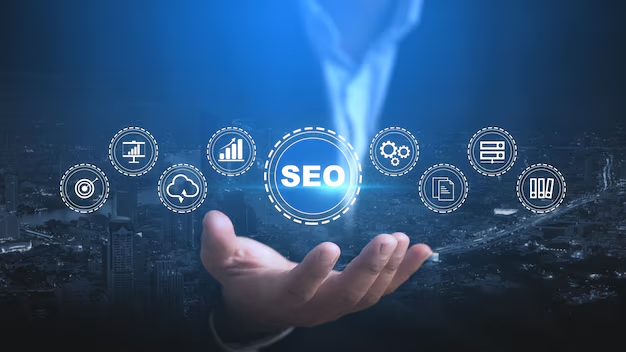
Most of us want the same simple thing: when someone needs exactly what we offer, our name shows up. But here’s where it gets tricky, too many businesses still treat SEO like a weekend project. Sprinkle a few keywords around, tidy up the homepage, and hope for the best. It might feel productive, but search engines have long outgrown that kind of surface-level work. Real visibility today runs on deeper signals. Think of your website as a conversation between two listeners: a potential customer with a question, and a search engine trying to match that question to the best possible answer.
Modern SEO is really just the art of closing that gap. It aligns how real people search, often in full, spoken sentences, with how search engines and AI assistants parse your content. Get that alignment right, and you don’t just rank; you become the go-to answer in traditional results, voice replies, and the generative summaries popping up everywhere. Miss it, and even a solid business stays invisible.
Why Do Websites Lose Search Visibility Without Clear SEO Direction?
A website may publish informative content, but search engines need more than information—they need structure. If headings are inconsistent, links break, or pages load slowly, algorithms cannot understand the site properly. This is why visibility drops even when new content is added regularly. Search engines reward clarity, and anything that disrupts it affects ranking.
Common Issues That Hurt SEO Performance
- Headings: Unclear or inconsistent structure
- Speed: Slow loading from heavy scripts and images
- Intent: Content misaligned with user search behaviour
- Links: Broken internal links that block crawling
- Mobile: Poor responsiveness on phones and tablets
- Metadata: Missing or outdated SEO details
A Complete SEO System for Users and Search Engines

A complete SEO system brings clarity and direction to your website. It ensures that content serves user needs while also meeting technical expectations from search engines. When these elements work together, rankings and engagement improve naturally.
How a Balanced Approach Supports Growth?
Modern SEO requires a combination of technical seo optimization during the website development and thoughtful content planning. On-page SEO services to improve website ranking include refining headings, improving internal linking, and placing keywords naturally. When your content aligns with search intent, search engines interpret it more confidently and reward it with stronger visibility.
Core Elements of On-Page Optimization
- Keywords: Naturally integrated for relevance
- Links: Logical internal connections
- Flow: Smooth, easy-to-read paragraphs
- Tone: Consistent and clear messaging
- Intent: Content organized around user needs
Why Voice Search Optimization Matters Today?
Voice search has reshaped how people interact with information. Users speak their questions in complete sentences, and search engines prefer content that mirrors natural speech. Websites that adapt to this shift gain stronger placement in voice-driven results.
How Search Behaviour Has Shifted?
Voice searches are longer, conversational, and intent-focused. Instead of typing SEO services, users ask, What are the best SEO services to improve my ranking? Content written in a natural tone becomes more compatible with voice search systems. This increases the likelihood that assistants like Siri and Google Assistant will present your content.
Features of Voice Search-Friendly Content
- Tone: Conversational, human-like wording
- Answers: Quick, direct responses
- Match: Headings aligned with spoken questions
- Clarity: Simple language that avoids complexity
- Flow: Natural transitions between ideas
SEO With GEO and AEO: New Ranking Factors Businesses Forget

Search behaviour is increasingly influenced by location and the need for direct answers. GEO SEO and AEO help your website stay relevant across both traditional searches and AI-driven results.
Why Local and Answer-Based Signals Matter?
GEO and SEO connects your content to regional search behaviour, With the help of google my business optimization, it easier for audiences in specific areas to discover your brand in local areas. AEO, or Answer Engine Optimization, prepares your website for systems that rely on extracting clear answers, such as AI search engines and smart assistants. These methods help modern websites reach users more efficiently.
Practical Elements of GEO SEO and AEO
- Location: Clear signals for regional relevance
- Answers: Direct responses for AI extraction
- Structure: Clean H1 → H2 → H3 hierarchy
- Readability: Short paragraphs and simple flow
Why Businesses Struggle to Grow With SEO?
Many businesses work on SEO but still fail to see meaningful growth. The issue is rarely the effort—it’s the lack of a structured approach that ties all content and technical elements together.
Gaps That Hold Back Visibility
A website may publish regular content, yet ranking remains flat because search engines cannot understand the bigger picture. When pages feel disconnected or promotional, search engines hesitate to rank them. Strong SEO requires consistency in structure, intent, tone, and technical performance.
Mistakes That Limit SEO Results
- Keywords: Treating SEO as keyword repetition
- Tone: Overly promotional writing style
- Links: Missing or weak internal linking
- Tech: Ignoring performance improvements
- Intent: Misalignment between content and user needs
How a Strong SEO Strategy Fixes These Issues?
A strong SEO strategy brings stability to your website. It connects every page, aligns content with search intent, and improves overall performance. This unified direction helps search engines develop a clearer understanding of your site’s purpose.
Why Strategy Outperforms Quick Fixes?
Quick fixes may improve ranking temporarily, but only a structured approach creates long-term visibility. When your content, layout, and technical foundation all support each other, search engines reward your site with more consistent placement. Users also benefit from a smoother, more intuitive experience.
Improvements That Strengthen SEO
- Speed: Faster loading through optimization
- Hierarchy: Strong, predictable heading structure
- Schema: Added context for search engines
- Writing: Clear, natural, problem-solving content
- Clarity: Controlled keyword usage
The Role of Professional Support
SEO evolves constantly, and keeping up can be challenging for businesses focused on daily operations. This is where expert support becomes valuable.
When Expert Help Makes a Difference?
A skilled SEO agency evaluates content, structure, performance, and user behavior to create a balanced strategy. By relying on proven methods, they eliminate guesswork. A professional team like Hivenexis can unify your technical SEO, content planning, and AI-search optimization to build long-term ranking strength.
What Professional SEO Work Usually Includes?
- Audit: Full technical website review
- Planning: Structured content strategy
- Voice: Voice-search and AI optimization
- Local: GEO SEO for regional ranking
- On-page: Layout and linking improvements
FAQs about Search Engine Optimization
Is traditional SEO still important now that AI gives direct answers?
Definitely. AI tools might serve up quick answers, but they still need a source they trust, and that’s where traditional SEO earns its keep. When your site loads fast, your content is clearly organized, and you actually show you know what you’re talking about, the odds of being the site quoted in an AI summary or voice result shoot way up. The basics aren’t optional anymore; they’re the price of entry.
How do I optimize for Google’s AI Overviews and answer engines?
Put your answer right at the top of the page, plain and simple. Give a clear, no-fluff reply to the exact question you want to rank for, then back it up with well-organized details below. Use headings that sound like real questions people ask, write the way you’d explain something to a friend, and keep your information current. When an AI can scan your page and instantly pull a clean, direct answer, your content becomes prime material for featured snippets and voice responses.
Does voice search optimization still matter in 2026?
Absolutely, it’s just blended into everyday conversation now. We talk to our cars, glasses, fridges, and phones without thinking twice. That means your content needs to sound like a real person speaking, not a textbook. Structure your pages around the full questions people actually say out loud, and don’t forget to make any visual descriptions helpful too, because voice and screen results often show up together.
What is entity-based SEO and why does it help rankings?
Search engines are way beyond matching keywords. They now map out real-world things, people, places, brands, concepts, and figure out how they connect. To play along, use consistent names and terms, group your content around clear themes, and add a little structured markup to spell out the relationships. When Google sees your site as a tidy hub of connected knowledge, you’re far more likely to land in knowledge panels and AI-generated answers.
How does GEO help a local business show up in 2026 searches?
For a local shop, GEO means becoming the obvious recommendation when a voice assistant or AI puts together a shortlist for someone nearby. Keep your Google Business Profile spotless, correct hours, fresh photos, exact address. Encourage customers to leave reviews that mention specific products or experiences. Then create blog posts or pages that calmly answer hyper-local questions like which bakery near me opens earliest on Sunday? When your business is consistently helpful and locally dialed in, algorithms naturally gravitate toward you for all those near me searches.
The Bottom Line
Good SEO these days isn’t about tricking anything. It’s about being so clear, well-organized, and genuinely useful that both people and AI can’t ignore you. Build your site with real expertise, make answers easy to find, and you’ll show up whether someone is typing, talking, or glancing at a summary. If you’re ready to quit chasing shortcuts and future-proof your visibility, let’s map out a straightforward, human-first strategy together.
Grab a free 30-minute strategy call and let’s get your site working smarter.